Most kitchens get renovated once. Not once per owner, once per house, and the decisions made during that renovation tend to live in the walls and the cabinetry and the backsplash grout for decades, whether anyone still likes them or not. It’s one of the reasons a kitchen renovation can feel so loaded: you’re not just picking finishes, you’re selecting finishes you’ll still be looking at in fifteen years, on an ordinary Wednesday morning when you’re not thinking about design at all.
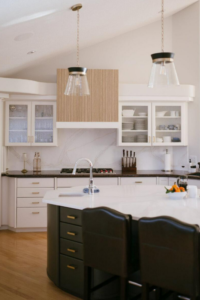
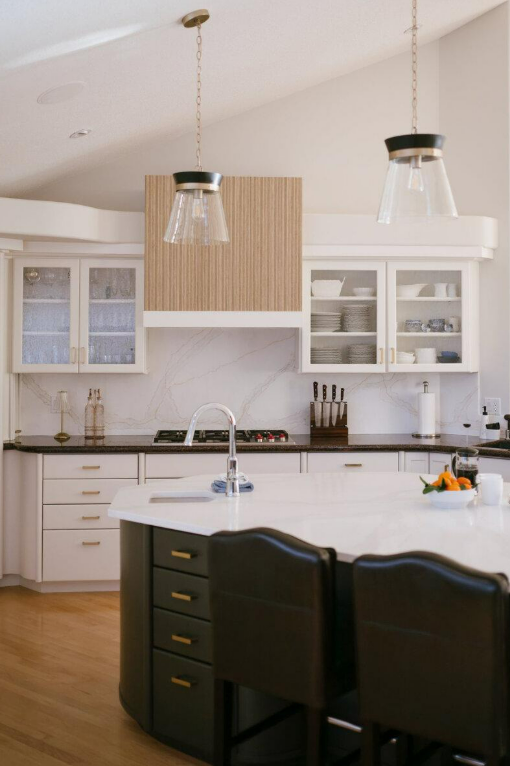
The kitchen at this Varsity Estates home was approached with exactly that in mind. Not what would photograph well or what was trending in showrooms that season, but what would still feel right years down the road, when the house had settled further into itself, and the people living in it had too. The perimeter cabinetry is white with a simple shaker profile, the kind that’s become a classic for a reason.
Paired with brushed gold hardware that develops warmth over time, it’s a combination that asks very little of you going forward. White quartz on the island for ease and brightness, dark granite along the perimeter where the real cooking happens and durability matters most.
The full-height finish behind the range looks like a matching stone slab, but it’s actually a custom, hand-troweled microcement plaster, colour-matched to the new island quartz. Removing the existing tile behind the kitchen’s original corner cabinets would have meant a bigger, more expensive job than this kitchen needed, so the plaster solved it instead, giving the wall the same clean, uninterrupted look without tearing out what was already there. Running it all the way to the upper cabinets rather than stopping at counter height is a small call with an outsized effect, the kind of thing you notice in the room without being able to name why it works.
The reeded tile hood surround introduced the one material in the room that wasn’t hard, smooth, or white, chosen because it needed to withstand daily cooking and wipe clean easily, not just look good. Without it, the space would have been beautiful and a little cold. With it, the room settles. The glass pendants hang from the vaulted ceiling above the island, providing light without making a production of themselves.
What the photos can’t show is how the space moves. How someone at the range can carry something to the island without a single awkward step, how the glass-front uppers invite you to keep the things worth seeing visible, how the whole room just makes sense the moment you’re in it. Those details reveal themselves slowly, over hundreds of ordinary mornings.
None of this is about having the most impressive kitchen on the street. It’s about a kitchen that still makes sense on an ordinary Wednesday, years after the renovation’s finished and nobody’s thinking about design at all.
If you’ve been thinking about what your kitchen could become, we’d love to start that conversation with you. Book a Discovery Call here.